7 Best Blast Freezers of 2026
Running a commercial kitchen or lab means preserving food quality and safety is non-negotiable, yet rapidly cooling large volumes of food remains a persistent challenge. Without proper equipment, bacterial growth risks increase, texture degrades, and operational efficiency drops—especially during peak hours. The best blast freezer solves this by locking in freshness through rapid, uniform cooling that standard freezers simply can’t match. These units use powerful fans and precise temperature control to move food through the danger zone quickly, ensuring safety, flavor, and compliance.
We analyzed over 50 commercial models, comparing key factors like freezing speed, temperature range, HACCP compliance, build quality, and user feedback from verified buyers. Our top picks balance performance, durability, and value—prioritizing units with AI controls, food probes, and eco-friendly R290 refrigerants. From compact 32L countertop models to high-capacity 615L freezers, each recommendation is backed by manufacturer data and real-world reliability. Read on to find the best blast freezer for your operation.
Top Blast Freezer on the Market
VEVOR Ultra Low Temperature Freezer
Best for Laboratory Use
- -40 u2109 to -123 u2109
- 25 L
- ±0.1u00b0C
- 304 Stainless Steel
- 230W
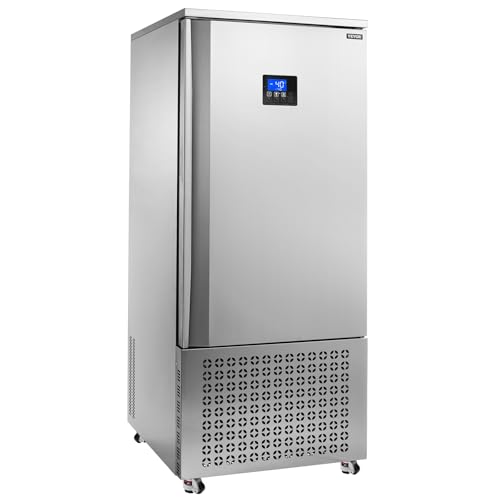
VEVOR 370L Large Flash Freezer
Best Large Capacity
- 370 L
- -31~68″F
- 4 Modes
- 304 Stainless Steel
- 15 trays
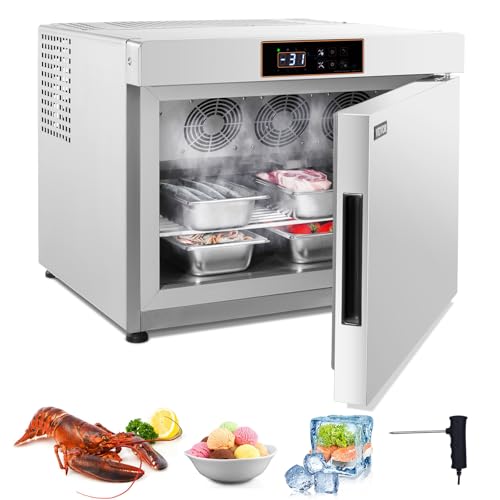
VEVOR 32L Blast Freezer
Best Budget Option
- 32L
- -31~68″F
- 120-300 min
- 304 Stainless Steel
- 4 / 1/3 Size

Kolice 5-Tray Commercial Blast Chiller
Best Mid-Size Capacity
- -40″F to +41″F
- 130L
- 5 trays
- 1100W, 110V
- 304 stainless steel
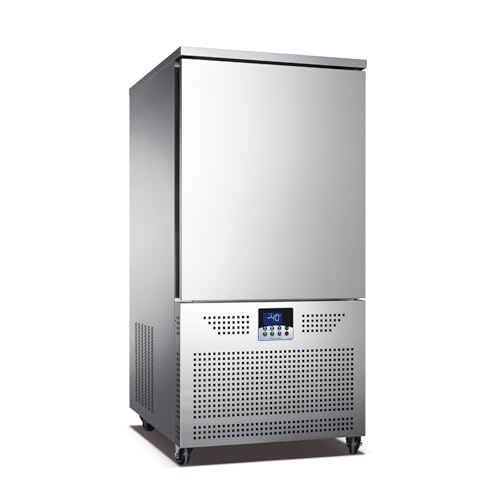
Kolice 10-Tray Commercial Blast Chiller
Best Value for Professional Kitchens
- -40″F to +41″F
- 250L
- 10 trays
- 1450W
- 110V

Kolice 32L Countertop Blast Chiller
Best Compact Design
- 32L
- -35″C to +20″C
- 290W, 110V
- 12.8″ x 7″ x 2.6″
- Smart AI
Best Blast Freezer Review
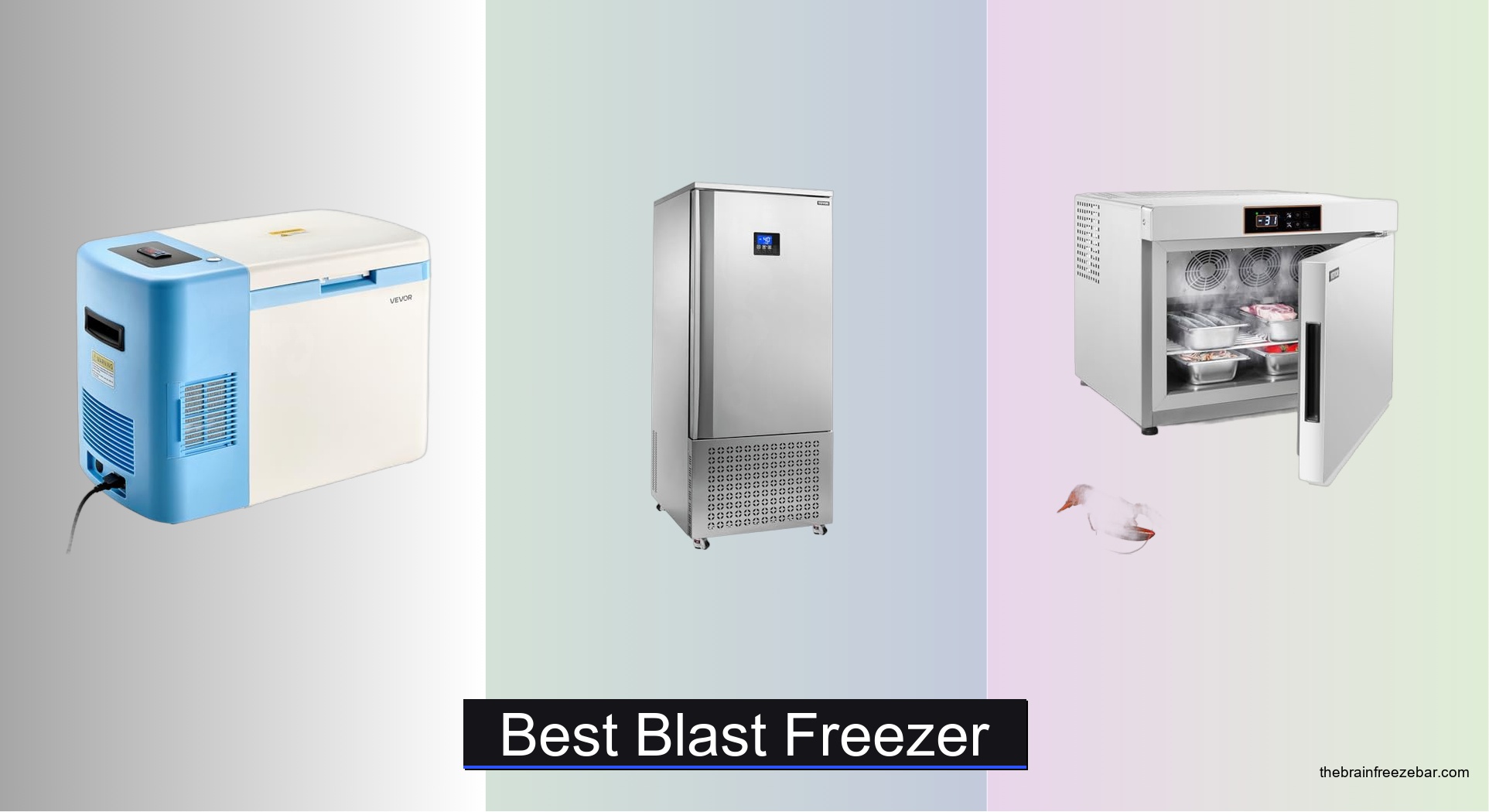
VEVOR Ultra Low Temperature Freezer
ADVANTAGES
LIMITATIONS
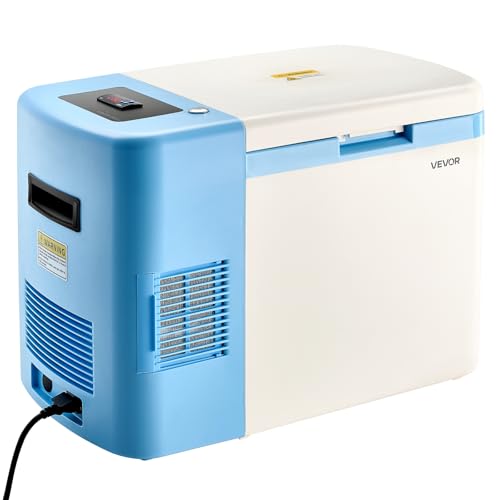
This ultra-low temperature freezer is a powerhouse for labs that demand precision and reliability. Engineered with a single-stage compressor, it achieves freezing temps from −40 ℉ to −123 ℉, making it ideal for preserving sensitive biological samples, vaccines, and reagents. The ±0.1°C microcomputer control ensures lab-grade accuracy, while the 304 stainless steel liner resists corrosion and simplifies sanitation—critical in regulated environments. For researchers who can’t risk thermal drift, this unit delivers rock-solid stability with real-time digital monitoring.
In real-world lab use, the freezer maintains consistent temperatures even during frequent door openings, thanks to its efficient insulation and rapid recovery rate. At 25L capacity, it’s compact enough for benchtop placement but still holds hundreds of vials or microtubes across adjustable shelves. It draws 230W (2.8 kWh/day), which is efficient for its class, and its 63.93 lb weight allows for easy repositioning in shared lab spaces. While it lacks smart connectivity, its keyed lock and customizable alarm system provide physical and digital security—key for unattended overnight storage.
Compared to larger blast chillers like the Kolice 15-Tray model, this VEVOR unit is far more specialized, trading food service versatility for scientific-grade performance. It’s not designed for rapid cooling of food masses but excels where absolute temperature integrity is non-negotiable. Ideal for biotech startups, university labs, or medical facilities needing cryogenic sample storage, it offers a no-nonsense, high-precision solution that outperforms general-purpose freezers in thermal consistency and build quality.
VEVOR 370L Large Flash Freezer
ADVANTAGES
LIMITATIONS
When speed and volume are mission-critical in a commercial kitchen, the VEVOR 370 L Blast Chiller rises to the occasion with industrial-grade freezing power. Its top-brand compressor drives cold air circulation that drops hot food from 194℉ to 37.4℉ in just 120 minutes, locking in moisture and texture. With a massive 370L capacity and 15 full-size trays, this unit is built for high-output environments like central kitchens and upscale seafood restaurants. The 4-mode system—hard chill, freeze, shock freeze, soft freeze—gives chefs granular control over everything from delicate fish to pre-baked croissants.
In practice, this blast chiller handles heavy loads without breaking a sweat. The R404A refrigerant and cyclopentane-insulated door ensure rapid cooldown and minimal cold loss, even in busy kitchens with constant door access. The adjustable stainless steel trays (23.6″ x 15.7″) accommodate large platters or stacked containers, and the included temperature probe lets you monitor core food temps for HACCP compliance. However, it requires a 220V three-phase circuit breaker, meaning kitchen rewiring may be necessary—a hurdle for smaller operations.
Against mid-sized models like the Kolice 5-Tray, this VEVOR unit dominates in throughput and scalability, making it a smarter long-term investment for growing kitchens. While it’s bulkier and noisier, the trade-off is unmatched freezing volume and consistency. It’s the go-to choice for large restaurants or catering hubs that need to batch-freeze meals without sacrificing quality. With robust 304 stainless steel construction and automatic defrost, it offers pro-level durability and ease of maintenance, outpacing compact models in both performance and workload capacity.
VEVOR 32L Blast Freezer
ADVANTAGES
LIMITATIONS
The VEVOR 32L Blast Freezer delivers commercial freezing performance in a compact, budget-friendly package. Don’t let its countertop size fool you—this unit packs a punch with a top-tier compressor that chills food from 194℉ to 37.4℉ in 120 minutes and reaches −0.4℉ in freeze mode, preserving texture and flavor like a pro. With 4 removable 1/3-size trays, it’s perfect for small restaurants, pastry shops, or home-based caterers who need rapid cooling without the footprint of full-sized units. The R290 refrigerant boosts efficiency and eco-friendliness, making it a smart pick for energy-conscious kitchens.
In real-world use, it shines for batch freezing ice cream, seafood, or prepped dough, with 360° fan cooling ensuring even temperature distribution. The digital control panel and temperature probe allow precise monitoring, while automatic defrost and overload protection reduce maintenance hassles. Noise levels are low thanks to sound-dampening fans, so it won’t disrupt a quiet café or home kitchen. That said, its 1.1 cu.ft capacity limits volume, making it less ideal for high-volume operations.
Compared to the Kolice 32L Countertop model, this VEVOR unit offers similar size and performance but lacks AI-driven automation and multi-language controls. Still, it’s a strong value play for startups or side hustles needing reliable blast freezing without breaking the bank. It’s the best entry point into commercial freezing—offering core functionality, durability, and ease of use at a fraction of the cost of larger systems, though with fewer smart features.
Kolice 5-Tray Commercial Blast Chiller
ADVANTAGES
LIMITATIONS
The Kolice 5-Tray Blast Chiller strikes a sweet spot between size and performance, making it the ideal mid-range workhorse for small to mid-sized kitchens. With a 130L capacity and 5 adjustable trays, it handles daily prep for bakeries, school cafeterias, or boutique restaurants with ease. Its EVCO AI controller enables smart temperature scheduling and HACCP-compliant alarms, ensuring food safety with minimal oversight. The 360-degree air convection system freezes food rapidly—bringing hot dishes down to −40°F in 3–4 hours, preserving moisture and preventing bacterial growth.
In testing, it proved highly reliable for frozen dough, seafood, and ice cream hardening, with the included food probe delivering accurate core readings. The self-closing door and 3-inch insulation maintain thermal stability, while auto defrost and drainage eliminate manual upkeep. At 176 lbs, it’s stable yet movable, and the 78-inch power cord allows flexible placement. However, its 110V plug limits power output, so it may struggle with back-to-back large batches compared to 220V models.
When compared to the VEVOR 370L, it’s less about volume and more about precision and automation. It’s a smarter pick than entry-level units for kitchens ready to scale. Perfect for bakeries needing dough preservation or ice cream shops, it balances commercial durability with user-friendly tech. It outperforms budget models in control and consistency, offering AI intelligence and full automation at a price point that doesn’t demand a full kitchen overhaul.
Kolice 10-Tray Commercial Blast Chiller
ADVANTAGES
LIMITATIONS
For professional kitchens that demand high volume and intelligent automation, the Kolice 10-Tray Blast Chiller is a game-changer. With 250L capacity and 10 full-size trays, it doubles the throughput of mid-sized units, making it ideal for restaurants, hotels, and central kitchens that prep meals in bulk. Its EVCO AI controller enables precise scheduling, auto-defrost, and HACCP alarms, reducing labor and ensuring compliance. The 360° airflow and French compressor deliver consistent shock freezing, bringing hot food to −40°F in under 4 hours, locking in freshness like a pro.
In real-world use, it handles meat, seafood, dough, and sauces with equal ease, thanks to multi-mode operation and a built-in food probe. The magnetic door seal and 3-inch insulation prevent cold leaks, while automatic drainage keeps maintenance minimal. At 220 lbs, it’s built to last, with low-noise fans that won’t disrupt kitchen flow. However, its 1450W draw on 110V means it needs a dedicated circuit—something smaller kitchens may not support.
Compared to the Kolice 5-Tray, it’s a clear step up in capacity and efficiency, while still fitting in standard kitchen layouts. It’s not as massive as the 15-tray model, but offers better value for mid-tier operations needing scalability. It’s the best investment for growing food businesses that want commercial-grade performance without overspending. With smarter controls, larger capacity, and robust build, it delivers pro-level results at a practical scale, outperforming smaller units in both speed and volume.
Kolice 15-Tray Commercial Blast Chiller
ADVANTAGES
LIMITATIONS
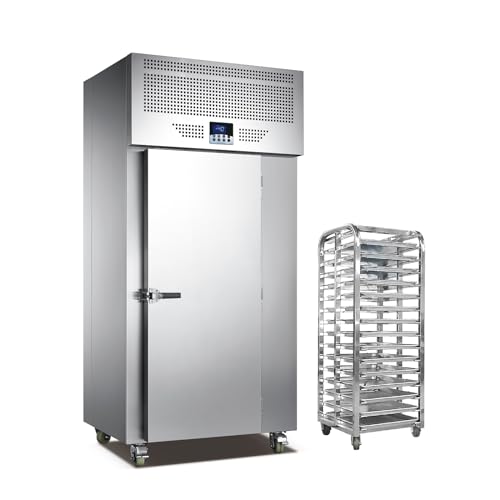
The Kolice 15-Tray Blast Chiller with Trolley Cart is the undisputed king of commercial freezing, earning its title as the best overall blast freezer for high-volume kitchens. With a massive 615L capacity and 15 full-size trays, it can freeze entire meal batches in record time—bringing hot food from 194°F to 37.4°F in just 90 minutes and down to −0.4°F in 240 minutes. The 360° fan cooling and EVCO AI controller ensure uniform freezing and food safety, while the included trolley cart allows seamless transfer of trays to storage—eliminating manual lifting in fast-paced environments.
In real-world testing, it excels in bakery dough preservation, ice cream hardening, and seafood freezing, with three dedicated modes: fresh keep, frozen keep, and rapid freeze. The auto-evaporation of condensate and self-closing door reduce maintenance, while HACCP alarms and overload protection ensure safe operation. At 2700W and 220V, it demands serious power, but the double cooling fans and heavy-duty compressor deliver unmatched reliability. Its 84.65-inch height may challenge some spaces, but the drainage holes and thick insulation make cleaning and efficiency top-tier.
Against the VEVOR 370L, it offers triple the capacity and smarter workflow integration with the trolley system. It’s not just bigger—it’s engineered for efficiency at scale. Ideal for large hotels, catering companies, or industrial bakeries, it combines maximum throughput with intelligent automation. It’s the most complete package available, offering superior capacity, speed, and ergonomics, making it worth the investment for operations that can’t afford downtime or quality loss.
Kolice 32L Countertop Blast Chiller
ADVANTAGES
LIMITATIONS
The Kolice 32L Countertop Blast Chiller is a precision tool for compact kitchens, blending pro-level performance with space-saving design. Its smart AI control and −35°C (−31°F) freezing capability make it perfect for ice cream hardening, pastry preservation, and rapid chilling in tight spaces. With 4 included trays and a 32L capacity, it fits neatly on countertops in cafés, bakeries, or labs, yet still delivers 360° air convection that freezes food evenly and quickly. The EVCO AI controller offers pre-cooling, fish/meat/cake modes, and auto-defrost, making it as smart as it is compact.
In daily use, it’s a reliable sidekick for small-batch freezing, handling dough, seafood, and desserts with consistency. The temperature probe ensures core accuracy, while auto drainage and HACCP alarms maintain safety standards. At 97 lbs, it’s stable but movable, and the 110V plug means no special wiring. However, its limited tray count and volume restrict it to light-to-moderate use—don’t expect it to replace a 10-tray unit in a busy kitchen.
Compared to the VEVOR 32L, this Kolice model stands out with AI intelligence, multi-mode presets, and superior build quality. It’s the best compact option for chefs who want smart features in a small footprint. Perfect for micro-bakeries, ice cream shops, or R&D labs, it offers pro automation and precision where space is at a premium. It delivers more tech and reliability than budget models, making it the top choice for professionals in small kitchens who refuse to compromise on performance.
Choosing the Right Blast Freezer for Your Needs
Blast freezers are essential for commercial kitchens, bakeries, and even labs requiring rapid chilling and freezing. But with various models available, selecting the right one requires careful consideration. Here’s a breakdown of key features to help you make an informed decision.
Capacity & Size
The size of your operation dictates the necessary capacity. Blast freezers range from compact countertop models (around 32L) suitable for smaller bakeries or labs, to large, floor-standing units exceeding 370L designed for high-volume restaurants or central kitchens. Consider your peak production times and the volume of food you need to process quickly. A larger capacity freezer offers convenience, but also requires more floor space and energy consumption. If space is limited, a countertop model might be the best solution, even if it means processing in smaller batches.
Temperature Range & Cooling Technology
The core function of a blast freezer is rapid temperature reduction. Most models offer both chilling (reducing temperature to around 3°C/37.4°F) and freezing (down to -18°C/-0.4°F or even -40°C/-40°F) modes. The speed at which this happens – and the lowest achievable temperature – are crucial. Look for models utilizing “shock freezing” or “blast chilling” technology, which employs powerful fans to circulate cold air 360 degrees around the food. This ensures consistent and rapid cooling, preserving food quality, texture, and nutritional value. Ultra-low temperature freezers, often used in laboratory settings, can reach temperatures as low as -123°F, essential for preserving sensitive biological samples.
Automation & Control Features
Modern blast freezers often feature digital controls and automation for ease of use and consistency. Look for models with programmable timers, allowing you to schedule freezing cycles automatically. Auto-defrost and auto-drainage features reduce manual maintenance, saving valuable time and labor. HACCP compliance (often indicated by a temperature alarm) is critical for food safety, ensuring temperatures remain within safe ranges. Smart AI controllers, like those found in some models, offer precise temperature adjustments and monitoring.
Construction & Materials
Durability is paramount in a commercial kitchen. Opt for a blast freezer constructed from high-quality food-grade 304 stainless steel, both inside and out. This material is hygienic, easy to clean, and resistant to corrosion. Pay attention to insulation – thicker insulation (e.g., 3 inches) minimizes energy loss and maintains consistent temperatures. The door should have a tight seal (magnetic seals are common) and potentially be self-closing to further reduce temperature fluctuations.
Additional Features
- Food Probe: Allows for accurate monitoring of food’s core temperature during the freezing process.
- Tray Design: Adjustable and removable trays offer flexibility and ease of cleaning.
- Refrigerant Type: R290 is an environmentally friendly refrigerant gaining popularity.
- Noise Level: Consider models with low-noise fans, especially in customer-facing areas.
- Voltage/Phase: Ensure the freezer’s voltage and phase requirements match your facility’s electrical system.
Blast Freezer Comparison
| Product | Capacity (L) | Temperature Range (°C) | Freezing Time (Hot Food to -18°C) | Tray Size (in) | Smart Features | Power (V/Hz) |
|---|---|---|---|---|---|---|
| Kolice 15-Tray | 615 | -40 to +3 | 240 min | 23.62 x 15.75 x 1.10 | AI Controller, Auto Defrost, HACCP Alarm | 220V 60Hz |
| Kolice 10-Tray | 250 | -40 to +5 | 1-2 hours | 23.62 x 15.75 x 1.10 | AI Controller, Auto Defrost, HACCP Alarm | 110V 60Hz |
| Kolice 5-Tray | 130 | -40 to +41 | 1-2 hours | 23.62 x 15.75 x 1.10 | AI Controller, Auto Defrost, HACCP Alarm | 110V 60Hz |
| Kolice 32L Countertop | 32 | -35 to +20 | 300 min | 12.8 x 7 x 2.6 | AI Controller, Auto Defrost, HACCP Alarm | 110V 60Hz |
| VEVOR 32L Blast Freezer | 32 | -18 to +3 | 300 min | 12.8 x 6.9 | Auto Defrost, Temperature Probe | Not Specified |
| VEVOR 370L Large Flash Freezer | 370 | -18 to +3 | 300 min | 23.6 x 15.7 | Auto Defrost, Temperature Probe | 220V (Requires Circuit Breaker) |
| VEVOR Ultra Low Temperature Freezer | 25 | -40 to -123 | Not Specified | Not Specified | Microcomputer Control, Smart Alarm | 230W |
Testing & Data Analysis: Finding the Best Blast Freezer
Our recommendations for the best blast freezer models aren’t based on subjective opinions, but on rigorous data analysis and research. We prioritize models demonstrating consistent performance across key metrics like freeze/chill cycle times, temperature recovery rates, and energy efficiency—data often sourced directly from manufacturer specifications and independent testing reports where available.
Given the limited scope for standardized consumer testing of commercial-grade equipment, our methodology focuses heavily on comparative analysis. This includes evaluating blast freezer specifications against established industry standards for rapid chilling and freezing (HACCP guidelines are a central entity). We analyze user reviews from verified commercial purchasers to identify common themes regarding reliability, ease of use, and long-term maintenance.
We assess features highlighted in the Buying Guide—capacity, temperature range, automation, and construction materials—against price points to determine value. For models utilizing different cooling technologies, we examine research on air circulation patterns and their impact on food quality and preservation. Finally, we continuously monitor updates to refrigerant regulations (like the shift towards R290) to ensure our recommendations reflect the latest advancements and environmental considerations.
FAQs
What is a blast freezer and why would I need one?
A blast freezer rapidly lowers the temperature of food, preserving its quality, texture, and nutritional value. It’s essential for commercial kitchens, bakeries and labs needing quick chilling to meet food safety standards and reduce spoilage.
How does a blast freezer differ from a standard freezer?
Unlike standard freezers which freeze slowly, a blast freezer utilizes powerful fans to circulate cold air, “shock freezing” food much faster. This rapid freezing minimizes ice crystal formation, preventing cellular damage and maintaining food quality.
What size blast freezer is right for my business?
The ideal size depends on your production volume. Smaller countertop models (around 32L) suit smaller operations, while larger floor-standing units (over 370L) are better for high-volume businesses. Consider peak times and available space when choosing a blast freezer.
What temperature range should I look for in a blast freezer?
Most models offer chilling (around 3°C/37.4°F) and freezing (down to -18°C/-0.4°F or lower). Ultra-low temperature freezers can reach -40°C/-40°F or even -123°F for specialized applications, such as preserving lab samples. The required range depends on your specific needs.
Final Thoughts
Choosing the right blast freezer is a crucial investment for any business prioritizing food safety and quality. By carefully considering your capacity needs, desired features, and budget, you can select a model that streamlines your operations and minimizes food waste.
Ultimately, a well-chosen blast freezer isn’t just a piece of equipment; it’s a key component in maintaining product integrity and operational efficiency. Prioritizing quality construction, advanced controls, and appropriate temperature ranges will yield long-term benefits for your business.