Commercial Freezer Floor Repair: Quick Fix Guide
Your commercial freezer floor is failing right now—even if you haven’t noticed the damage yet. That subtle pitting near the door threshold, the barely visible cracks forming in high-traffic zones, and the slight unevenness under your forklift wheels all signal the beginning of concrete deterioration that will inevitably lead to operational disasters. Commercial freezer floor repair isn’t just about fixing cosmetic damage; it’s about preventing catastrophic facility shutdowns, avoiding food safety violations, and protecting your bottom line from escalating repair costs. This guide reveals exactly how freezer floors fail, what repair options actually work in sub-zero environments, and how to restore your critical infrastructure with minimal downtime—so you can keep products moving and regulators satisfied.
Ignoring minor floor damage creates a ticking time bomb in your cold storage operation. Spalled concrete surfaces trap bacteria that standard cleaning can’t reach, putting your facility at risk for failed health inspections and costly recalls. Pitted areas collect moisture that freezes into dangerous slip hazards every time doors open. Equipment vibrations from uneven surfaces accelerate wear on expensive material handling systems. Most critically, every hour of unplanned downtime costs food processing facilities an average of $25,000 in lost production—making proactive commercial freezer floor repair one of the highest-return investments you can make in operational continuity.
Why Your Freezer Floor Is Crumbling Right Now
The freeze-thaw cycle relentlessly destroys your concrete from the inside out, with each door opening triggering a new wave of damage. When warm, humid air enters your freezer during product loading, moisture condenses on the floor surface and penetrates concrete pores through capillary action. As temperatures drop below freezing, this trapped water expands 9% as it turns to ice, generating hydraulic pressure that exceeds concrete’s tensile strength. These microscopic fractures accumulate with each temperature swing, eventually causing surface spalling that progresses to complete structural failure—especially in high-traffic zones where equipment traffic drives moisture deeper into the concrete matrix.
Door thresholds and entry points experience 3-5 times more freeze-thaw cycles than interior areas, accelerating damage where it matters most. Forklift traffic compounds the problem by breaking down surface aggregates and creating micro-cracks that invite more moisture penetration. In food processing facilities, frequent washdowns add significant moisture loads that continuously feed this destructive cycle. Standard concrete installations lack the air-entraining properties needed to accommodate ice expansion, making them fundamentally unsuited for freezer environments without specialized repair systems.
Spot These Critical Warning Signs Before Failure
Surface spalling appears first as small pits and divots where the concrete surface layer has separated from underlying material—typically beginning in high-traffic zones and door entrance areas. These early signs often go unnoticed until they progress to create rough surfaces that impede equipment movement or trap debris during cleaning. As spalling advances, larger sections of concrete break away, exposing coarse aggregate beneath and creating potential contamination harborage points that violate food safety regulations. Don’t wait for visible damage—schedule professional assessment if you notice:
- Rough texture underfoot in specific traffic lanes
- Water pooling in low spots after cleaning
- Increased vibration when moving equipment
- Visible aggregate exposure near door thresholds
Cracking patterns provide essential diagnostic information about underlying damage. Random surface cracks typically indicate freeze-thaw damage progressing through the concrete matrix, while linear cracks often signal structural movement at construction joints. In severe cases, complete concrete failure manifests as sections that have crumbled away entirely, leaving exposed subgrade and creating immediate operational hazards. Any visible deterioration requires professional evaluation because the underlying damage typically extends 2-3 times deeper than surface indicators suggest.
Fix Walk-In Freezer Floors with Industrial Epoxy Systems

Professional epoxy coating installations create seamless, non-porous surfaces that withstand sub-zero temperatures while eliminating the cracks and pits where contaminants hide. The repair process starts with aggressive surface preparation—shot blasting or mechanical grinding removes all degraded concrete and creates the optimal profile for coating adhesion. This critical step takes 2-4 hours per 500 square feet but determines whether your repair lasts 2 years or 10. Following preparation, technicians apply a penetrating primer that seals the concrete substrate and establishes the bonding layer for subsequent epoxy layers.
The complete system includes:
– Moisture-tolerant primer coat (applied at 10-15 mils wet film thickness)
– Intermediate build coats (typically 20-30 mils each)
– UV-stable topcoat formulated for low-temperature flexibility
– Optional anti-slip aggregate broadcast for high-moisture areas
These multi-layer systems maintain adhesion through extreme thermal cycling, preventing the cracking and delamination that plague less sophisticated coatings. The resulting seamless surface provides the smooth, non-porous texture required for effective sanitation while withstanding forklift traffic and frequent washdowns. Most professional installations achieve full operational readiness within 24 hours, with light equipment traffic permitted after just 8 hours at -20°F.
Repair Major Damage with Rapid-Set Concrete Systems
When spalling has progressed to structural damage, rapid-set concrete repair systems deliver functional strength in hours rather than the days required for conventional concrete. Standard concrete repairs fail prematurely in freezer environments because they lack air-entraining properties to accommodate moisture expansion during freezing cycles. Professional services use air-entrained rapid-set concrete that creates microscopic void spaces within the cured material, providing expansion room for freezing moisture without generating damaging internal pressure.
The repair process involves:
1. Removing all degraded concrete using jackhammers and concrete saws (4-6 hours for a 10×10 ft area)
2. Preparing the exposed subgrade with vapor barrier if needed
3. Applying bonding agent to existing concrete edges
4. Placing rapid-set repair material before initial set begins
5. Finishing to match surrounding floor elevation
These specialized systems achieve sufficient strength for equipment traffic within 4-6 hours at freezer temperatures, allowing facilities to resume normal operations by the next shift. The air-entrained formulation resists future freeze-thaw damage far more effectively than standard concrete, extending repair longevity by 3-5 times in demanding freezer environments.
Solve Blast Freezer Floor Failures with Specialized Systems

Blast freezers and Individual Quick Freezing (IQF) systems destroy standard repairs through extreme thermal gradients and rapid temperature drops. Standard epoxy formulations become brittle and lose adhesion when subjected to the temperature extremes (-40°F and below) encountered in blast freezing applications. Professional repair services specify specialized polyurethane and hybrid polymer-cement systems that maintain flexibility and structural integrity through these extreme conditions.
Technicians working in blast freezer environments must complete repairs during narrow maintenance windows, typically achieving:
– 80% of work during planned 8-12 hour shutdowns
– Seamless transitions between repaired and existing surfaces
– Thermal cycling resistance to -50°F with minimal expansion/contraction
The most critical factor in blast freezer repairs is ensuring complete adhesion at the material-substrate interface. Any weak points where thermal stress concentrates will initiate new failure within weeks. Professional services verify adhesion through pull-testing and ensure proper material selection based on specific freezer operating parameters.
Restore Sanitary Conditions While Fixing Floor Damage
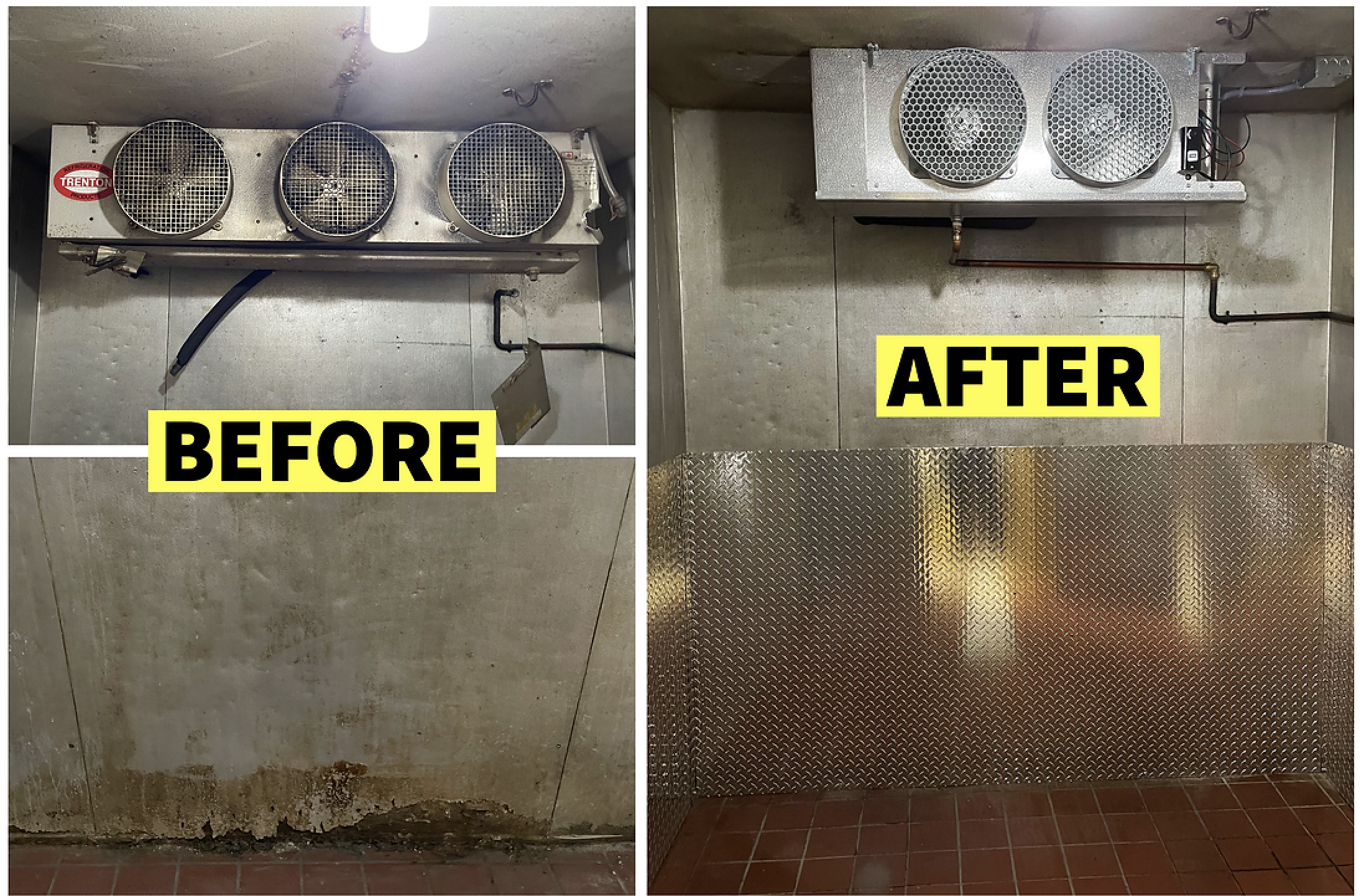
Deteriorated freezer floors create significant sanitation challenges that repair must address to maintain food safety compliance. Pitted, spalled, and cracked surfaces trap food particles, cleaning chemicals, and biological contaminants that resist thorough removal during normal cleaning procedures. The rough texture of degraded concrete provides harborage sites for bacteria and microorganisms, creating contamination risks in facilities handling food products.
Professional commercial freezer floor repair restores sanitary conditions by:
– Creating smooth, non-porous surfaces that facilitate effective cleaning
– Eliminating cracks, crevices, and pits where contaminants accumulate
– Properly sealing floor-to-wall transitions and drain installations
– Incorporating antimicrobial additives in topcoat systems
The seamless epoxy and polymer systems installed during repair eliminate the harborage points that trigger regulatory citations during health inspections. This restoration of effective sanitation capability represents a significant operational benefit beyond just structural repair, supporting facility compliance while reducing cleaning time and chemical consumption.
Choose Repair Services That Minimize Your Operational Downtime
Professional freezer floor repair services maintain crews trained in expedited repair techniques and stock specialized materials formulated to cure quickly at low temperatures. This readiness enables completion of significant repairs within hours rather than days—turning what would be a multi-day shutdown into an overnight operation. When selecting a repair contractor, confirm they can:
- Achieve functional strength in under 6 hours at -20°F
- Work effectively in sub-zero installation environments
- Complete repairs during your scheduled maintenance windows
- Provide manufacturer-certified installation of cold-temperature systems
The most effective downtime minimization strategy combines early damage detection with scheduled repair work during planned operational pauses. Facilities that address floor issues before they reach crisis levels typically achieve 75% less downtime than those requiring emergency repairs. Ask potential contractors for documented case studies showing return-to-service times for projects similar to yours—this concrete evidence matters more than price quotes alone.
Prevent Future Freezer Floor Damage with These Proven Strategies
Once your commercial freezer floor has been repaired, implement these preventive measures to extend service life:
– Install air curtains or strip doors to reduce warm air infiltration
– Schedule regular inspections of high-traffic areas for early spalling
– Maintain proper drainage to prevent water pooling at vulnerable points
– Implement equipment traffic management with designated pathways
– Use cleaning protocols that minimize standing water after sanitation
These preventive measures, combined with the improved surface characteristics of properly installed repair systems, can extend the interval between repair cycles by 40-60%. Most importantly, they maintain safer, more sanitary floor conditions throughout your facility while protecting your repair investment from premature failure. Schedule professional assessments annually to catch developing issues before they escalate into costly repairs.
Final Note: Don’t wait for concrete failure to force emergency repairs that shut down your operation. Address freezer floor damage at the first signs of spalling to protect food safety compliance, prevent equipment damage, and avoid costly production interruptions. The right repair solution applied at the right time delivers years of reliable service in even the most demanding freezer environments.